Recent posts

  1. Top 50 retail chains in Belgium and the Netherlands

    Comments Off on Top 50 retail chains in Belgium and the Netherlands

    Albert Heijn retains leading position in the Netherlands, changing of the guard in Belgium

    In the Netherlands, Albert Heijn remains the chain with the most shops (1,017), but with the opening of 10 new branches, Kruidvat has closed the gap slightly and now has 985 shops. The gap to number 3 in the list is large, as Jumbo follows in 3rd place with more than 300 fewer branches than Kruidvat. There have been two shifts in the top 10. Service Apotheek has been making great strides in recent years and added another 14 pharmacies to its chain last year. With 514 pharmacies, they have taken over 7th place from Etos this year. New to the top 10 is Plus, which has moved into 10th place following the conversion of the last Coöp branches last year.

    The biggest climber in the Dutch Top 50 is Wibra, which opened 44 new stores last year, partly due to the acquisition of a number of former Blokker premises. This has seen Wibra rise from 34th to 27th place. RegioBank saw the largest decline in the Top 50, with the number of branches falling from 380 to 317 due to the conversion of branches to ASN. RegioBank thus dropped from 17th to 22nd place.

    In terms of square metres of retail space, Albert Heijn remains the undisputed largest chain in the Netherlands with 1.4 million m², followed at a considerable distance by Jumbo with 900,000 m². Here too, Plus has gained a place, jumping over Intratuin to 6th place.

    Belgium

    In Belgium, the number of Crelan branches decreased by almost 100 last year, meaning that Crelan is no longer the largest chain in Belgium. Bpost, with a smaller decrease in the number of branches, is the new number 1 this year. Once again, there are four chains of banks and insurance offices in the top 10, but together they lost 138 branches last year. Some of these chains will therefore also drop out of the top 10 in the coming years.

    In the top 50, the biggest climber is Daenens dienstencheque, which entered the top 50 in 35th place. Last year, Daenens merged its seven subsidiaries under one common name, which explains this strong growth.

    Supermarket chains dominate the top 10 in terms of retail space. In 2024, Colruyt managed to take over the number 1 position from Aldi. This year, they have managed to maintain their leading position and the difference has become even greater. The Dutch number 1, Albert Heijn, is also in the Belgian top 50, but in 19th place.

    Would you like to see the full list?

    Yes, I want the top 50 of 2026

    Request a demo

    Are you interested in learning more about European retail data and the ins and outs of our platform? Request a demo now and contact one of our residing experts.
    Request a demo

  2. Dutch retail vacancy rates rose in 2025 despite positive sentiment

    Comments Off on Dutch retail vacancy rates rose in 2025 despite positive sentiment

    Last year, several reports were published in which real estate professionals stated that Dutch physical retail had bottomed out and was once again a growth sector.

    Cushman and Wakefield, for example, stated in Vastgoedmarkt: “After years of uncertainty, retail property is once again popular with all types of investors. After fifteen years of turmoil, the retail market is now entering calmer waters.”

    Meerdervoort wrote in Vastgoedjournaal: “Physical shops have reinvented themselves. They have become part of retailers’ omnichannel strategy. They offer experience, visibility and service, and they remain crucial for everyday purchases. In fact, in many medium-sized cities, we are seeing shopping centres performing better than expected.”

    The CBS also reported positive figures: last November, physical shops saw a 3.8% increase in turnover compared to the same month a year earlier.
    Our footfall counts also showed a further upturn, with visitor numbers in shopping areas rising by 3% compared to 2024.

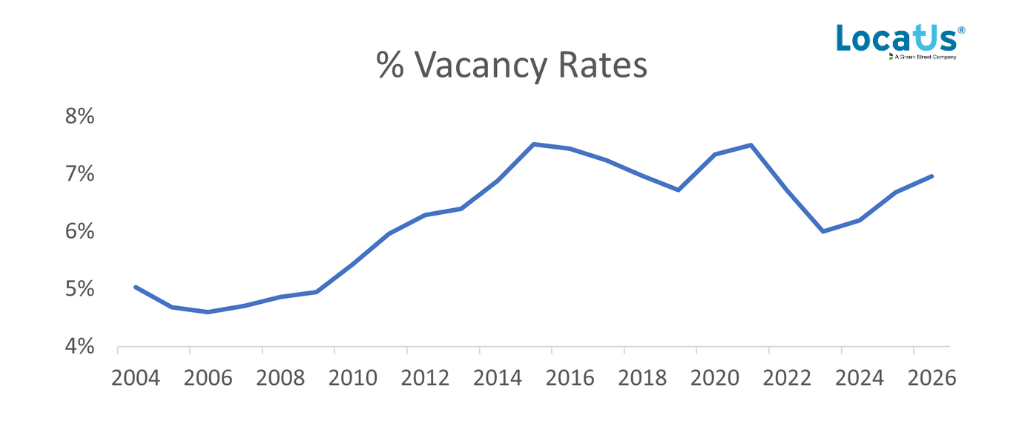
    However, despite this, vacancy rates rose again last year, from 6.7% at the beginning of the year to 7.0% now, although the increase in 2025 is less than in 2024, when vacancy rates rose from 6.2% to 6.7%.

    A decline in the number of retail properties

    In addition to an increase in vacancy rates, last year saw a decline in the number of retail properties for the tenth year in a row. Last year, there were just over 207,000 properties, now there are 1,600 fewer, with just over 205,000 remaining, of which nearly 14,000 were vacant last year and now more than 14,000.

    Despite the positive signs, we are still seeing a decline in the number of properties, and of the remaining properties, more are vacant. As in previous years, the decline in the number of properties was entirely due to a decrease in the number of retail properties, while the number of properties in the hospitality, leisure and services sectors remained virtually unchanged last year.

    The number of retail properties fell below 80,000, compared to 107,000 twenty years ago, a decrease of 26%. Despite the decline in the number of properties, the number of retail square metres remained stable for a long time, but in recent years the number of occupied retail square metres has also been falling.

    Differences between shopping areas

    Vacancy rates rose in almost every type of shopping area, with the sharpest increase seen in Retail Parks. These are mainly furniture boulevards. Since 2020, this type of shopping area has experienced an upturn. Money that could not be spent on holidays ended up here, with the result that the vacancy rate in this type of centre fell to 4.5%. In recent years, however, we have also seen problems here, such as the bankruptcy of CarpetRight, and we are seeing vacancy rates rise in these centres. In the 15 largest city centres in the Netherlands, we saw vacancy rates fall slightly again last year.

    The trend we have been seeing for some time, whereby the largest centres are performing better than the smaller ones, was evident again last year. Consumers go to the largest centres in the Netherlands for their serious shopping. In smaller centres, the focus is increasingly on everyday amenities.

    Request a demo

    Are you interested in learning more about European retail data and the ins and outs of our platform? Request a demo now and contact one of our residing experts.

    Request a demo

  3. Footfall in touristic European cities doubled

    Comments Off on Footfall in touristic European cities doubled

    This spring Locatus conducted a large-scale shopping footfallcount in 32 European cities. From Amsterdam to Athens, from Milan to Manchester, we counted pedestrians at strategic locations.

    (more…)

  4. Top 50 Retail chains of Belgium and The Netherlands

    Comments Off on Top 50 Retail chains of Belgium and The Netherlands

    Bpost relinquishes its number one position to Crelan. This is due to the June 2024 merger between AXA and Crelan, which continued together under the name Crelan. As a result, they rose by a whopping 288 outlets (vkp) and Crelan went from #4 to #1 in the Belgian ranking.  

    (more…)

  5. Retail vacancy rate in Luxembourg drops after years of increase

    Comments Off on Retail vacancy rate in Luxembourg drops after years of increase

    We’ve seen the vacancy rate in Luxembourg rise steadily for years, from 6% in 2015 to 10.1% at the beginning of 2022. Eighteen months after this peak, the national vacancy rate is back down to 8.7%. The vacancy rate is on a downward trend despite the aftershock of Covid 19 and rising inflation, just like in Belgium and the Netherlands. The main cause behind the vacancy decline is that the number of retail properties is decreasing due to change of function. (more…)

  6. Which industries stand out most in Belgium?

    Comments Off on Which industries stand out most in Belgium?

    Change is gradual. The baker leaves, a new lunchroom opens, and the shoe store moves two streets away. In small steps, the shopping street changes. But how major are the differences after 10 years?

    (more…)

  7. Which industries stand out most in the Netherlands?

    Comments Off on Which industries stand out most in the Netherlands?

    Change is gradual. The baker leaves, a new lunchroom opens, and the shoe store moves two streets away. In small steps, the shopping street changes. But how major are the differences after 10 years?

    Every year, Locatus processes adjustments for around 15% of its retail database. (For those who don’t know us yet, our database really does contain every point of sale in the Benelux). So after 10 years, the retail landscape will most definitely look different. Last week I dove into our database and took a closer look at the shifts at sector level. What stood out?

    In this blog, I compare January 2013 to the most recent data (July 2022).

    Outliers based on number of retail outlets

    • Most grown (%)
      The Electro repair sector has relatively grown the most (+338%). From 193 stores in 2013 to 788 stores by mid-2022.
    • (Almost) Extinct
      The sector Video Store is almost extinct. Of these, only 18 stores can still be found throughout the Netherlands. Meanwhile, Post Offices have become completely extinct. The last store closed in 2018, while there were still 512 post offices in 2013.
    • Decreased by more than 1.000 stores per sector
      Sector Shoes                    : -40,0% (-1.384 stores)
      Sector Women’s fashion   : -17,5% (-1.209 stores)
      Sector M&F fashion          : -14,5% (-1.002 stores)
    • Most additional retail outlets
      The Delivery/Take-away sector has grown the most in terms of number of retail outlets: + 2.361 (+111%). This sector now has 4,485 retail outlets. We have seen steady growth here for more than 10 years, but during the corona-pandemic the industry received an additional boost.

    Service sector dominates Growth Top 10

    The industries that are growing most (in number of retail outlets) almost all sell services, rather than products.

    • Top 10 Industries grown most (in total number of outlets)
    1. Delivery/take-away
    2. Service station
    3. Hairdresser
    4. Cafe-Restaurant
    5. Fitness
    6. Lunchroom
    7. Beauty salon
    8. Fast food
    9. Second hand miscellaneous
    10. Nail salon

    Apparently, more and more people want to look good, while eating in or out, and subsequently want to work off the extra pounds….

    Outliers bases on Retail Floor Space

    • Highest RFS
      The Supermarkets sector is at the top of the list when it comes to RFS. In second and third place are home improvement stores and furniture stores. These have a much larger average floor area, but are much less densely spread.
    • Most increased (in RFS)
      The Supermarkets sector also added the most store meters: + 860,000 m² in 10 years, or 21.8%. The second largest sector, Secondhand miscellaneous stores, grew by 379,567 m².
    • Most declined (%)
      Three sectors pretty much share their first place when it comes to percentage of most shrinkage (between 60 and 61%): Computer, Sound & Vision and Office Supplies. The first two are selling more and more online, while the last sector is selling less and less because we simply use fewer pens and writing materials.
    • Most decreased in RFS
      The department store sector has shrunk the most in absolute terms in terms of RFS (- 344,825 m²). The demise of V&D has left its mark on vacant retail floor space for a long time. The buildings often turn out to be too large for other retailers and thus the giant spaces are often converted for other (retail) purposes.

    Locatus has 217 different sectors in its database. Each sector develops differently. Would you like to know more about a specific sector? Or what would be a suitable sector distribution for your shopping area? Do not hesitate to ask us about our Sector & Formula Analysis.

    One last piece of sector knowledge: Did you know that there are 52 sectors in the Netherlands in which only independent entrepreneurs are active (i.e. no retail chains)?

  8. The Benelux retail market in key figures

    Comments Off on The Benelux retail market in key figures

    There are stores everywhere. Even the small village, I grew up in had two small supermarkets, a bicycle shop, a bakery and a drugstore. And probably a few more stores I don’t remember. But what are we talking about when we look at the big picture? How many retail outlets do Belgium or the Netherlands have? (more…)

  9. Extremely few store closures in 2021

    Comments Off on Extremely few store closures in 2021

    Early 2021.

    For once, everyone agreed: there was no other way; with large-scale vaccination programs coming, stores would re-open. And in this “New Normal”, many stores were not going to survive without government support. It seemed obvious.

    Things turned out completely differently.

    (more…)